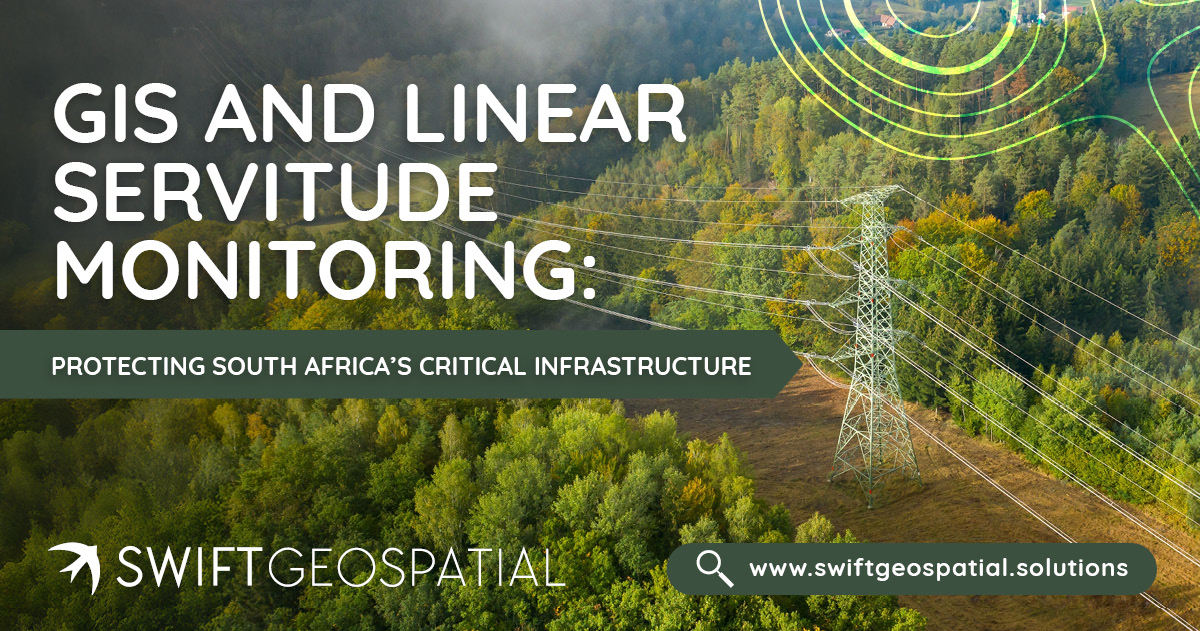
GIS and Linear Servitude Monitoring: Protecting South Africa’s Critical Infrastructure
Encroachment into linear servitudes is a growing risk for South African infrastructure. Swift Geospatial’s GIS monitoring solutions help detect unauthorised activity early, maintain legal compliance, and protect critical assets across powerlines, pipelines, railways, and fiber networks.
Categories:
Date Posted:
July 23, 2025
GIS and Linear Servitude Monitoring: Protecting South Africa’s Critical Infrastructure
Across South Africa, utility providers, local governments, and infrastructure operators are confronting a growing problem: encroachment into legally protected linear servitudes. These servitudes include the designated corridors that carry critical infrastructure such as powerlines, gas and water pipelines, railway tracks, and fiber optic cables. These systems form the backbone of the country’s economy and society, enabling everything from electricity distribution to communication and transport.
As cities expand into surrounding areas, informal settlements multiply, and agricultural boundaries shift outward, the pressure on these servitudes increases. Many of these developments occur without formal planning or approval. Over time, this results in unauthorised structures being built, trees growing too close to high-voltage lines, or even farming operations overlapping pipeline routes. When servitude zones are compromised, the consequences can be severe. Public safety is put at risk, essential services are interrupted, and infrastructure owners may face legal battles or regulatory penalties.
In this challenging environment, Geographic Information Systems (GIS) provide a powerful solution. By using high-resolution satellite imagery, spatial data analysis, and real-time alert systems, GIS allows infrastructure managers to monitor servitudes with a high degree of accuracy. Whether managing a single corridor or a national network, GIS enables early detection of risks, supports faster decision-making, and ensures that preventative action can be taken before minor encroachments escalate into major disruptions.
GIS-based monitoring is not just a reactive tool. It enables a shift towards proactive, data-driven infrastructure management. With GIS, organisations can map servitude boundaries clearly, track change over time, and access digital records to support legal or compliance processes. This approach saves time and resources while increasing the reliability of South Africa’s most critical infrastructure systems.

What Is a Linear Servitude?
A linear servitude is a designated and legally protected strip of land that grants infrastructure owners and operators the right to install, operate, and maintain continuous infrastructure assets. These assets typically stretch over long distances and include:
- Electricity transmission lines, such as Eskom’s high-voltage corridors that connect power stations to substations and urban centres
- Gas and water pipelines, which transport essential resources across provinces and rural areas
- Railway lines, enabling the movement of freight and passengers along key economic routes
- Fiber optic and telecommunications cables, supporting connectivity and digital infrastructure across the country
The purpose of a linear servitude is threefold. First, it ensures public and environmental safety by keeping hazardous or high-risk infrastructure separated from populated or sensitive areas. Second, it guarantees unobstructed access for maintenance and inspections, allowing utility crews and technicians to carry out essential work without legal or physical barriers. Third, it helps minimise risks posed by nearby development, such as structural collapse, fire, or interference with service delivery.
In South Africa, servitudes are clearly regulated and often defined by minimum width requirements depending on the type of infrastructure. For example, high-voltage powerlines may require a 15 to 30 metre clearance on either side of the line. These zones must remain free of permanent buildings, unapproved farming activities, or tree planting that may interfere with infrastructure operation.
Despite these legal boundaries, encroachment remains a persistent challenge. In peri-urban zones surrounding Johannesburg, Durban, and Cape Town, rapid informal housing development frequently spills into servitude areas. In rural regions such as Mpumalanga, Limpopo, and the Free State, agricultural expansion, mining activity, and land-use shifts often result in servitudes being crossed, fenced off, or used without permission.
Unchecked, these infringements put infrastructure and human lives at risk. They also create complications for service providers who may face delays in maintenance, increased repair costs, and potential legal liability. This makes the accurate monitoring and management of linear servitudes not only a compliance issue but a critical operational priority.


Theft and Illegal Tapping of Pipelines
In addition to housing encroachment and unregulated farming, theft and illegal tapping of pipelines have become serious threats to infrastructure corridors in South Africa. Criminal groups and opportunistic individuals often target fuel and gas pipelines for unauthorised extraction. These activities cause substantial financial losses and create dangerous conditions for nearby communities and the environment.
Illegal tapping typically involves digging into the pipeline corridor and installing makeshift valves or fittings to siphon fuel. In many cases, small storage tanks or temporary structures are hidden within informal settlements, dense vegetation, or farmland, making detection difficult through routine visual inspections. These operations are often well-concealed and may go unnoticed for weeks or even months.
The consequences can be severe. Tampered pipelines can rupture or leak, resulting in fires, explosions, and widespread environmental contamination. In areas like Sasolburg and Secunda, illegal tapping has led to incidents requiring costly emergency responses and cleanup. These incidents also disrupt fuel distribution and place additional pressure on supply chains across the country.
Geographic Information Systems play a key role in addressing this issue. With high-resolution satellite imagery and change detection tools, GIS makes it possible to spot small but suspicious changes along pipeline routes. Indicators such as fresh vehicle tracks, soil disturbance, or new access paths can signal illegal activity. In higher-risk zones, drone surveillance and thermal imaging can be used to detect movement or heat signatures near pipelines.
Swift Geospatial’s Swift Detect solution is designed to support early detection by continuously monitoring pipeline servitudes for irregularities. When signs of unauthorised activity appear, the system generates alerts that can be shared with security teams or law enforcement for investigation. This approach enables quicker response times, helps prevent major incidents, and builds a body of evidence that can support prosecution.
Illegal tapping is not only a security problem. It is a growing threat to infrastructure safety, public health, and environmental protection. GIS gives operators the visibility they need to monitor vulnerable corridors more effectively and take decisive action when risks emerge.

What Counts as Encroachment?
Encroachment occurs when unauthorised development, activity, or land use takes place within the boundaries of a designated servitude. These activities often conflict with the legal, operational, and safety requirements of the infrastructure that the servitude is meant to protect.
In the South African context, encroachment is a widespread issue. It is driven by rapid urbanisation, informal land occupation, agricultural expansion, and poor enforcement of zoning regulations. Some of the most common examples include:
- Construction of informal housing beneath or near high-voltage powerlines, especially in urban and peri-urban areas like Soweto, Tembisa, or Khayelitsha. These structures expose residents to electric shock hazards and obstruct maintenance teams.
- Farming activities that overlap pipeline servitudes, particularly in provinces like Limpopo and the Free State, where commercial and subsistence farming expand into buffer zones. Trenches, irrigation lines, and heavy machinery can damage underground infrastructure.
- Tree planting and natural vegetation growth along transmission corridors, which can interfere with overhead lines, causing outages or sparking fires during dry seasons.
- Unapproved roadworks, fencing, or access gates installed within railway or fiber optic corridors, disrupting access and introducing risks of service interruption.
Encroachment into servitudes has serious consequences. It goes beyond legal non-compliance and can:
- Damage infrastructure, leading to costly repairs, extended outages, and system instability
- Increase the likelihood of fire, explosion, or electrocution, especially near fuel lines or electrical assets
- Hinder emergency and maintenance teams, making it difficult or impossible to access affected areas during breakdowns
- Expose infrastructure owners to legal disputes, fines from regulatory authorities, and loss of public or investor trust
In severe cases, such as when illegal structures are built directly over pipeline routes or high-voltage lines, the risk extends beyond inconvenience to potential disaster. Proactive monitoring and early intervention are therefore essential to reduce these risks and uphold the integrity of South Africa’s infrastructure.

How GIS Strengthens Servitude Monitoring
Managing linear servitudes across South Africa presents complex challenges. These corridors often span vast distances and pass through a variety of landscapes, including remote rural areas, farmland, informal settlements, and urban developments. Traditional monitoring methods, such as routine physical inspections, are costly, time-consuming, and often unable to keep up with the pace of change on the ground.
Geographic Information Systems (GIS) offer a more efficient, scalable, and proactive solution. By combining satellite imagery, spatial analysis, and digital tools, GIS enables infrastructure owners to monitor, detect, and respond to risks within servitudes with greater accuracy and speed. Here is how GIS strengthens the servitude monitoring process:
Define and Visualise Servitude Boundaries
GIS makes it possible to clearly map and visualise the legal boundaries of each servitude using cadastral data, survey records, and high-resolution satellite imagery. These digital maps show exactly where infrastructure corridors run and where development restrictions apply. They can also include overlays of land ownership, zoning, or municipal infrastructure.
For example, an electricity provider can use GIS to map a powerline corridor across the Northern Cape, ensuring teams understand the servitude’s width and limits. This clarity helps prevent misinterpretation in the field and ensures that contractors, municipal planners, and legal teams all operate from the same accurate reference.
Detect Encroachment Early
GIS platforms use historical and current imagery to detect changes within servitude areas. By applying change detection analysis, GIS can automatically identify new structures, vegetation growth, or land use changes that may signal encroachment. These systems can flag an informal dwelling built beneath a transmission line near Johannesburg or a new farm fence crossing a pipeline route in Limpopo shortly after it appears.
Frequent image updates make it possible to monitor activity with minimal delay, reducing the time between encroachment and response. This early detection is essential for preventing damage, service interruptions, and safety hazards.
Prioritise Risks and Coordinate Response
Not every encroachment presents the same level of risk. GIS allows servitude managers to classify and rank encroachment events based on their proximity to infrastructure, the potential for disruption, and the surrounding context.
For example, an informal settlement developing near a major substation in eThekwini would be prioritised higher than a small patch of crops near a fiber optic line in the Karoo. Using these classifications, teams can focus their resources on the highest-risk zones, reducing unnecessary site visits and improving overall response effectiveness.
Interactive dashboards built on GIS data provide an overview of all monitored areas, showing active encroachments, status updates, and trends over time. This helps decision-makers act quickly and strategically.
Support Compliance and Maintain Audit Trails
GIS systems record every action and event geospatially, creating a digital audit trail. Site inspections, photographic evidence, stakeholder communication, and corrective actions are all stored alongside the relevant location data.
This level of recordkeeping is essential for regulatory compliance in South Africa, including alignment with bodies like NERSA and SANRAL. If a dispute arises or legal proof of encroachment is required, these GIS records can demonstrate a clear history of monitoring and response. They also simplify reporting to authorities, internal departments, or insurance providers.

A Flexible, Scalable Solution with Swift Detect
In regions like the Karoo or the Northern Cape, where land use tends to change at a slower pace, Swift Detect can be configured for monthly or bi-monthly assessments. This reduces monitoring costs while maintaining effective oversight of long-distance infrastructure.
Infrastructure corridors vary widely in scale, location, and exposure to risk. Whether you are managing a national railway system, a regional power grid, or a rural water pipeline, the approach to monitoring needs to adapt to local conditions. Swift Geospatial’s Swift Detect solution offers the flexibility and scalability to meet these diverse requirements through a single, customisable platform.
In high-growth areas such as Gauteng, where rapid urban development and informal settlement expansion are common, Swift Detect enables daily monitoring using high-frequency satellite imagery. This supports early detection of encroachments and allows for timely intervention before safety or service delivery is affected.
In regions like the Karoo or the Northern Cape, where land use tends to change at a slower pace, Swift Detect can be configured for monthly or bi-monthly assessments. This reduces monitoring costs while maintaining effective oversight of long-distance infrastructure.
For harder-to-reach zones, such as steep slopes, dense bushveld, or ravines in provinces like Mpumalanga or KwaZulu-Natal, Swift Detect supports the integration of drone data collection. This ensures detailed coverage even in areas where satellite imagery may not capture fine-scale changes.
Clients are able to customise Swift Detect based on the type of infrastructure, location, risk level, and operational goals. The result is a monitoring solution that is both reliable and efficient, ensuring critical servitudes are continuously protected, regardless of terrain or scale.

Swift Geospatial’s Encroachment Monitoring Solutions
With Swift Detect, infrastructure operators across South Africa can confidently monitor their servitudes with greater accuracy, speed, and intelligence.
Swift Geospatial delivers a comprehensive, technology-driven approach to linear servitude monitoring by combining advanced GIS tools, satellite data partnerships, and deep experience working across South African landscapes. Our Swift Detect platform is designed to provide actionable insight, reduce operational risk, and help clients stay ahead of encroachment threats.
High-Frequency, High-Resolution Satellite Imagery
Through partnerships with Planet and Maxar, we offer both frequent revisit imagery and ultra-high-resolution coverage. This allows us to deliver near real-time monitoring and detailed assessments of infrastructure corridors in urban areas like Soweto, coastal towns such as Saldanha, and remote regions like the Soutpansberg.
Real-Time GIS Dashboards
Processed imagery and spatial analysis are integrated into Esri Dashboards, providing users with a clear, interactive view of current conditions. These dashboards help teams monitor change detection, track emerging hotspots, and prioritise response efforts. They are accessible via any web browser and can be integrated into internal systems through a REST API.
Custom Experience Builder Applications
Using Esri Experience Builder, we develop interactive web applications tailored to each client. These apps allow users to explore encroachment data, overlay servitude boundaries and land ownership layers, and generate compliance or legal reports — all within an intuitive, user-friendly interface that requires no technical GIS training.
Automated Alerts and Encroachment Reports
Our system is configured to issue real-time alerts when unauthorised development or vegetation growth is detected within servitude zones. Encroachment reports can be customised and distributed to operational teams, legal departments, or compliance officers, helping ensure swift, coordinated action.
Historical Change Detection and Custom Analysis
We provide advanced analytical services, including time-series change detection, encroachment risk scoring, and predictive modelling. By accessing Planet and Maxar’s extensive imagery archives, we help clients understand long-term patterns, assess cumulative risk, and develop forward-looking management strategies.
With Swift Detect, infrastructure operators across South Africa can confidently monitor their servitudes with greater accuracy, speed, and intelligence.

Providing infrastructure managers with the tools they need
Encroachment into linear servitudes is a significant and increasing risk to infrastructure networks across South Africa. It threatens the integrity of critical assets, disrupts service delivery, and places surrounding communities in harm’s way.
Geographic Information Systems provide infrastructure managers with the tools they need to shift from reactive response to proactive management. With early detection, accurate monitoring, and geospatially documented evidence, GIS supports both operational performance and legal compliance.
At Swift Geospatial, we understand the complexity of South African terrain, development patterns, and infrastructure demands. Our Swift Detect solution is built to address these challenges with the precision, scalability, and reliability that modern infrastructure requires.
Get in touch with us to explore how geospatial intelligence can help you protect your infrastructure corridors and reduce long-term risk.