Watching the Wall: Why Tailings Storage Facility Monitoring Can’t Be an Afterthought
Tailings Storage Facilities (TSFs) are among the most critical, and potentially dangerous, structures in mining. With several major disasters in recent history, mine owners must prioritise TSF monitoring to protect lives, land, and operations. In this post, Swift Geospatial explores how satellite technology provides a smarter, safer, and more cost-effective alternative to traditional aerial flyovers, delivering early warnings and consistent data, no matter how remote the site.
Categories:
Date Posted:
April 10, 2025
Why Tailings Dam Monitoring Can’t Be an Afterthought
Mining operations don’t just shape the landscape, they leave behind complex environmental and structural legacies. One of the most critical of these is the Tailings Storage Facility (TSF), commonly referred to as a tailings dam. These vast embankments hold the slurry waste left behind after mineral extraction, a mix of crushed rock, process water, and trace chemicals. And while they may look like still, shallow lakes from above, tailings dams are dynamic structures under constant pressure, literally and figuratively. Meaning that tailings dam monitoring services are now essential to mining operations.
At Swift Geospatial, we believe that monitoring TSFs isn’t just about compliance, it’s about protecting lives, the environment, and the future of your mining operation. With advances in satellite-based Earth Observation and geospatial analytics, it’s now possible to remotely monitor tailings facilities in real time, avoiding the risks, costs, and delays of traditional flyover inspections.
But before we explore how satellite technology is changing TSF monitoring, let’s unpack what tailings dams are and why they matter so much.
What Are Tailings Dams and Why Are They So Risky?
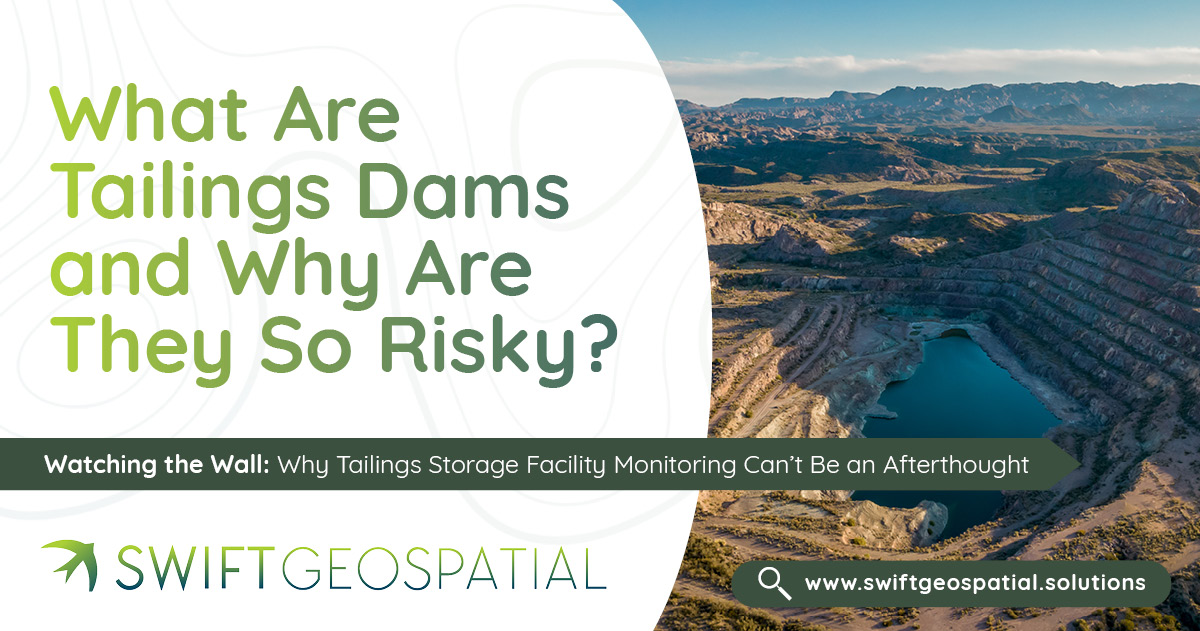
Tailings dams are large engineered embankments designed to contain the byproducts of mining. These slurry mixtures are pumped into containment basins, where solids settle, and water is recycled back into the processing plant. Over time, these structures can grow to massive sizes, some stretching for kilometers and containing hundreds of millions of cubic meters of material.
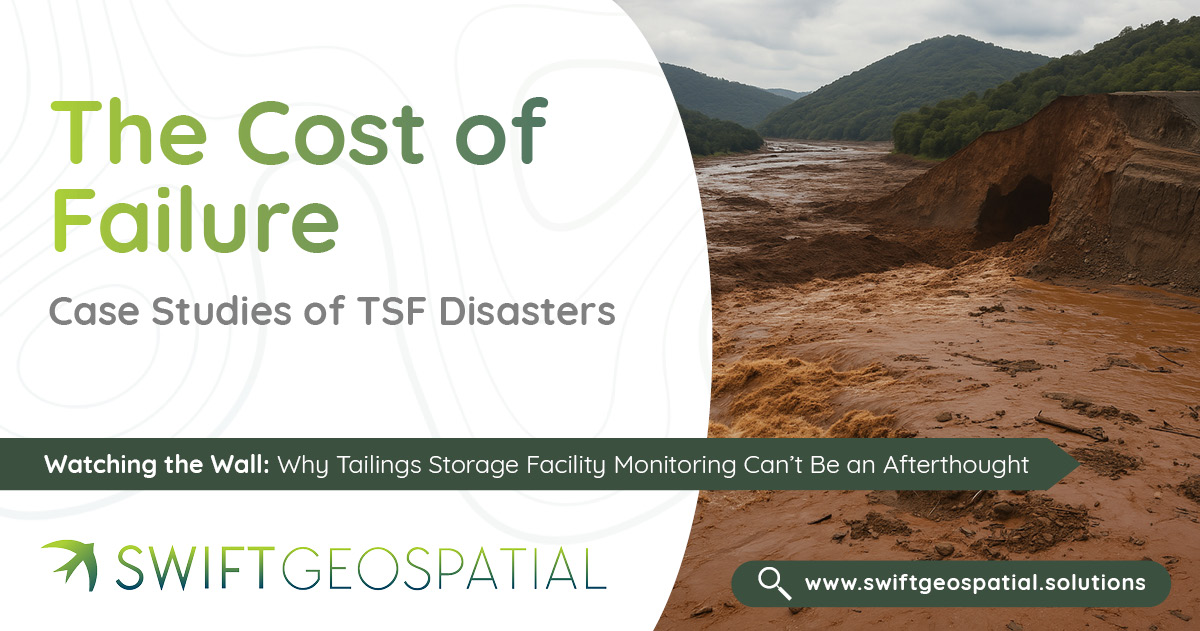
Unlike conventional water dams, tailings dams are built in stages, often using waste material from the mine itself. This makes them cheaper to construct, but also more prone to failure if not properly engineered and maintained. The risks associated with TSF failure are immense: toxic spills, loss of life, environmental destruction, legal fallout, and reputational collapse.
The Problem With Traditional Tailings Facility Monitoring
Historically, TSFs have been monitored through on-site inspections and aerial flyovers. While these methods have value, they come with critical limitations:
- Infrequency: Weekly or monthly flyovers may miss rapidly developing structural issues.
- Weather Dependency: Flyovers are often delayed by poor weather, leading to blind spots in data collection.
- High Costs: Aircraft hire, fuel, and labour costs quickly add up, especially for remote operations.
- Limited Coverage: Aerial imagery is constrained by the angle and area of capture, potentially missing subtle changes at dam crests or slopes.
With such significant risks involved, mining operations need a better solution. And that’s where satellite-based monitoring comes into play.
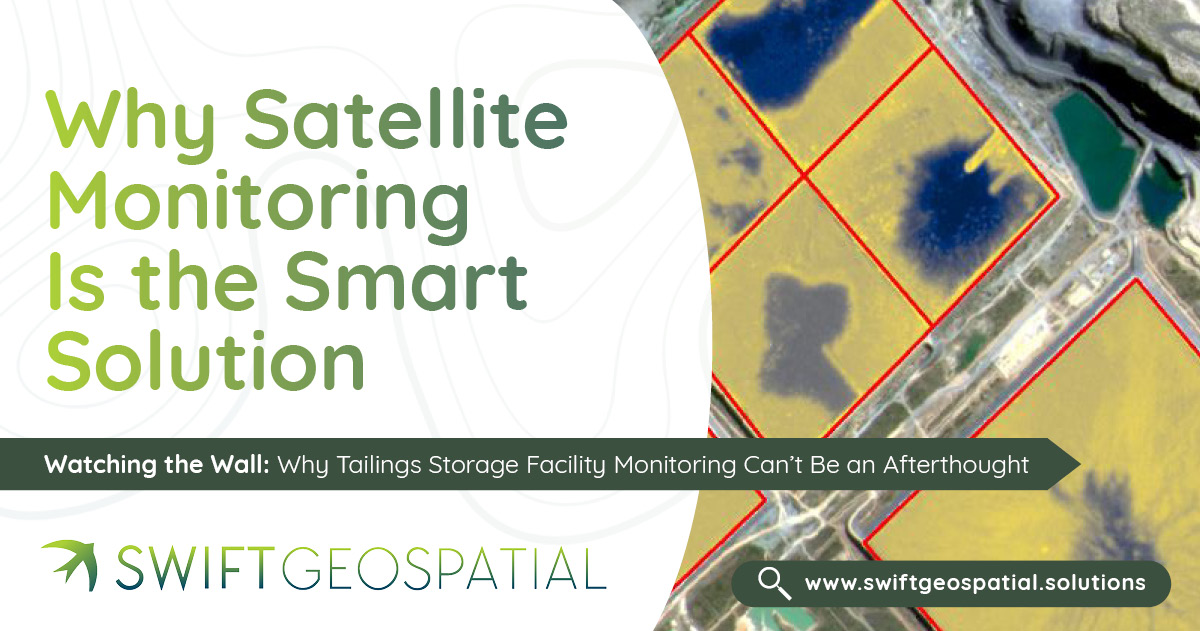
Why Satellite Monitoring Is the Smart Solution
At Swift Geospatial, we leverage high-resolution, multi-temporal satellite imagery combined with advanced geospatial analysis to monitor TSFs with unmatched consistency and precision.
Here’s why satellite monitoring outperforms flyovers:
Consistent Coverage: Satellites revisit the same location every few days, regardless of weather or accessibility.
- Surface Change Detection: We can identify subsidence, cracking, or bulging in the dam structure using.
- Automated Alerts: We set thresholds for change, triggering automatic alerts when movement exceeds safe limits.
- Historical Analysis: Satellite archives allow us to study a facility’s performance over years, providing insights that flyovers cannot replicate.
- Cost-Effective: Once in place, satellite monitoring requires no aircraft, no fuel, and no physical presence, just real-time intelligence delivered directly to your screen.
By using remote sensing, our clients can monitor every square meter of their TSF, every week, every month, every year, without missing a beat.
Environmental Monitoring: Not Just Compliance, It’s About Reputation
In today’s mining landscape, environmental monitoring isn’t just about ticking regulatory boxes, it’s about protecting your reputation and earning the trust of communities, regulators, and investors alike. With increasing pressure from all sides for greater transparency, responsible mining practices have become a key differentiator in securing long-term operational success. At Swift Geospatial, we equip mine owners with powerful tools to monitor environmental performance using high-resolution, repeatable Earth Observation data.
This includes tracking vegetation loss and regrowth through NDVI analysis, which helps verify the progress of land rehabilitation efforts. We also monitor changes in water bodies, whether due to rainfall, runoff, or sedimentation, ensuring any deviations from baseline conditions are detected early. Dust dispersion and particulate movement near tailings storage facilities can be visualised over time, giving clear insight into air quality management.
One of the most impactful uses of this technology is the ability to provide clear before-and-after satellite imagery that proves environmental restoration has occurred—essential for regulatory reports, ESG audits, and community relations. And because all of this is backed by third-party-verified satellite data, mine owners can rest assured that their environmental reporting is not only accurate but defensible in any forum.
A New Standard for Tailings Facility Monitoring
Tailings Storage Facilities (TSFs), or mine waste containment structures, are some of the most critical (and most vulnerable) components of modern mining infrastructure. The global disasters of the past two decades have shown what can happen when tailings facility surveillance is inadequate or outdated. But satellite technology is now redefining what it means to stay ahead of risk.
Swift Geospatial offers a smarter, safer way forward through remote sensing for tailings dams. Our geotechnical monitoring solutions provide continuous visibility into dam behaviour, allowing you to make informed decisions and act before issues escalate. No aircraft, no guesswork, just consistent, accurate, and cost-effective oversight delivered from space. If you’re ready to take your tailings infrastructure monitoring to the next level, contact the Swift Geospatial team today and start building a safer future for your operation.