The Evolution of GIS: Aerial Photography and the Mapping Revolution – Part 2
Let’s take a decade-by-decade walk into the history books and discover the evolution of GIS and the critical role of aerial photography in its growth into a vital element of today's technological driven society.
Categories:
Date Posted:
February 26, 2025
The Evolution of GIS: GIS in the 21st Century: A New Era of Possibilities
As the world entered the 21st century, Geographic Information Systems (GIS) began transforming in ways that were once unimaginable. From the rise of drones that brought unparalleled flexibility to aerial photography, to the seamless integration of real-time data and artificial intelligence, GIS became a dynamic force for innovation. This new era brought powerful tools to industries like agriculture, construction, and environmental conservation, making it easier than ever to capture, analyze, and act on data.
With advancements like cloud-based platforms and high-resolution satellite imagery, GIS moved beyond static maps and into a future of limitless potential. The 2000s set the stage, but the 2010s truly propelled GIS into a realm where possibilities became realities. Whether monitoring a single field or mapping entire cities, GIS in the 21st century reshaped how we understand and interact with the world around us.
Ready to see how these innovations unfolded and continue to shape our future? Let’s explore the incredible journey from 2000 onward.

2000s: Digital Aerial Photography and the Rise of Open GIS Platforms
In the 2000s, aerial photography began the shift from film to digital cameras. Aircraft-mounted digital cameras captured high-resolution imagery that could be processed and shared much faster than traditional methods. These advancements made aerial photos more accessible and versatile, fueling their use in GIS for applications ranging from urban development to disaster response.
The launch of Google Earth in 2005 revolutionized how the public interacted with GIS and aerial photography, kickstarting a huge advancement in the evolution of GIS understanding among the public. Suddenly, anyone with an internet connection could explore high-resolution imagery of the Earth. This democratization of geospatial data helped highlight the potential of GIS for everyday use.
During this decade, Esri introduced its ArcGIS platform, a powerful suite of tools that seamlessly integrated aerial photography with GIS workflows. Meanwhile, Maxar Technologies (then known as DigitalGlobe) became a leader in satellite imagery, providing high-resolution data that complemented aerial photographs for large-scale projects.
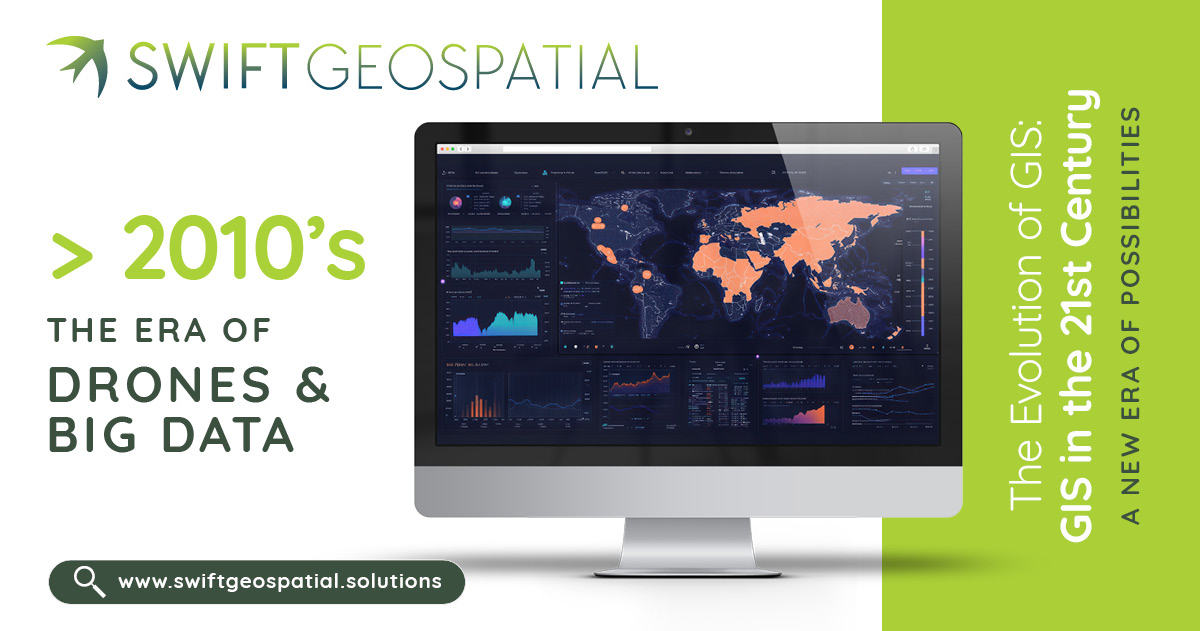
2010s: The Era of Drones and Big Data
The 2010s saw the rise of drones, transforming aerial photography by making it more affordable, flexible, and accessible. Drones could capture high-resolution images on demand, providing real-time data for industries like agriculture, construction, and environmental conservation. These images became essential for GIS, enabling detailed, localized analysis. Companies were able to task imagery capturing, enabling change detection through comparison of imagery and data captured.
Cloud-based platforms like Esri’s ArcGIS Online allowed users to store and share aerial imagery effortlessly, making GIS more collaborative and accessible. The integration of artificial intelligence (AI) into GIS workflows automated tasks like analyzing land use or detecting changes in landscapes.
Maxar Technologies continued to lead in the industry of high resolution satellite imagery, offering data that complemented drone and aerial photography for global projects. Planet Labs, founded in 2010, emerged as a key player, using small, low-cost satellites to provide near-daily imagery of the Earth. Together, these technologies created a more comprehensive view of our earth, with the ability to task satellites to obtain imagery if specific area’s of interest at a given time leading to change detection monitoring possibilities.

2020s: Mapping the future of GIS
Real-Time Monitoring
Aerial photography has long been valued for its ability to capture detailed snapshots of the Earth’s surface, and today, its potential is amplified by real-time applications. Drones equipped with high-resolution cameras are increasingly being used to gather localized, real-time data. These drones can fly over agricultural fields to monitor crop health, inspect forests for signs of deforestation, or survey urban areas for heat island effects.
Multispectral and thermal imaging from drones has opened new possibilities for sustainability. By capturing data across different wavelengths, these systems can identify stressed vegetation, track water use efficiency, and detect environmental pollution. This localized data feeds directly into GIS platforms, enabling decision-makers to act quickly and effectively.
The Integration of High-Resolution Satellite Imagery: Expanding the Scope of Environmental Monitoring
High-resolution satellite imagery has become a cornerstone of modern environmental analysis, offering expansive views that complement the detailed precision of aerial photography. This technology allows for monitoring vast regions over time, capturing critical data that helps researchers and decision-makers tackle complex environmental challenges on both local and global scales.
Innovators like Planet and Maxar have pushed the boundaries of satellite imaging, delivering tools that enhance our ability to monitor and understand the Earth. Planet’s Dove satellites, capturing daily 8-band multispectral imagery, provide vital data for applications like vegetation health, land-use monitoring, and soil analysis. Their Skysat satellites take this further, offering higher-resolution imagery with RGB, NIR, and an optional panchromatic band for unparalleled clarity, ideal for tracking environmental and urban changes in detail.
Maxar’s imaging capabilities are equally groundbreaking, offering up to 16 spectral bands, including Shortwave Infrared (SWIR), Near Infrared (NIR), and RGB. These advanced spectral ranges allow for unique applications, such as mapping soil moisture, identifying materials, and detecting vegetation stress, even in challenging weather conditions. This versatility positions Maxar as a key player in climate research, disaster recovery, and biodiversity preservation.
For climate change monitoring, satellites are able to track key phenomena like glacial retreat, rising sea levels, and pertinently deforestation. Planet’s frequent imaging identifies rapid changes, such as deforestation hotspots, while Maxar’s SWIR data detects subtle environmental shifts, providing a richer understanding of how ecosystems respond to stressors. Compliance to regional policy through ongoing monitoring is becoming more prevalent across the globe.
In biodiversity conservation, satellites map critical habitats and track wildlife populations over large areas. By identifying regions at risk of fragmentation or encroachment, conservationists can prioritize efforts to preserve ecological integrity. Urban planners also benefit from the satellite captured data, using it to design smarter cities with energy-efficient infrastructure and minimized environmental footprints.
As satellite technology continues to evolve, with greater spectral resolution, faster revisit times, and more powerful AI integration, its impact on environmental monitoring will only grow. Providers like Planet and Maxar are not just capturing data—they’re reshaping how we approach sustainability, conservation, and climate resilience. Together, these advancements are equipping us with the tools to navigate the challenges of the 21st century and build a future where human progress aligns with the planet’s needs.

What’s Next for GIS?
The field of GIS is evolving rapidly, with immersive technologies like augmented reality (AR) and virtual reality (VR) leading the charge. These innovations are revolutionizing how geographic data is presented, turning traditional maps into dynamic, interactive 3D experiences. Aerial photography plays a foundational role in creating these immersive models, supplying the visual data necessary for realistic simulations and deeper engagement with geographic systems.
In urban planning, AR allows professionals to overlay 3D models of proposed developments onto real-world views captured through aerial imagery. This helps planners and stakeholders visualize how new infrastructure will fit into and impact existing environments. Similarly, VR enables users to virtually “walk” through landscapes built from high-resolution aerial and satellite imagery, offering new ways to assess potential ecosystem changes or monitor the progress of conservation projects.
The Future of GIS and AI
As technology advances, the integration of satellite imagery, and GIS platforms will continue to unlock new possibilities for sustainability. Innovations like AI and machine learning are pushing the boundaries of what GIS can achieve, enabling systems to analyze, predict, and respond to larger data sets and changes in real-time. From monitoring rainforest health to planning greener cities or mitigating climate change, these tools empower decision-makers to act with greater confidence and insight.
By making complex geographic data easier to understand and navigate, GIS and aerial imagery are helping to create a more sustainable future—one where human progress and environmental stewardship go hand in hand.

Conclusion: How We at Swift Geospatial Leverage GIS and Satellite Imagery for a Better Future
From the first aerial photograph in 1858 to today’s cutting-edge drones and satellites, the evolution of GIS and earth observation has been nothing short of transformative. At Swift Geospatial, we’re proud to be part of this journey, leveraging the latest in satellite imagery and GIS technology to empower businesses with the data they need to make smarter, more sustainable decisions.
We combine high-resolution satellite imagery with advanced GIS solutions to monitor critical sectors like mining, agriculture, and forestry. Our tools provide real-time insights that help our clients optimize operations, reduce risks, and enhance environmental stewardship. Whether it’s tracking crop health, assessing forestry changes, or monitoring mining activities, our solutions give businesses a clear picture of what’s happening on the ground—and how to act on it.
Our mission is to help organizations harness the power of earth observation data to improve business outcomes while contributing to a sustainable future. By bridging the gap between cutting-edge technology and actionable insights, we empower decision-makers to operate more efficiently and responsibly.
As technology continues to advance, the integration of GIS and satellite imagery will open even more possibilities. At Swift Geospatial, we’re excited to lead the way, delivering precise, timely, and impactful data that drives meaningful change—for our clients, their industries, and the planet.